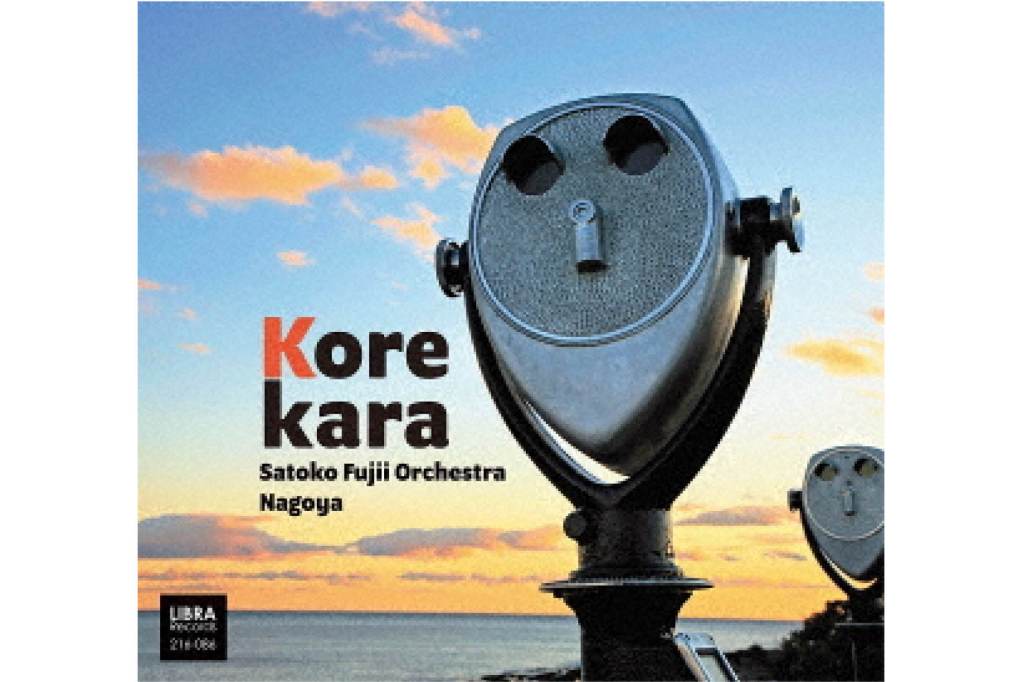
LIBRA RECORDS 216-086 (RELEASED OCTOBER 2)
Robert Rusch, founder of Cadence magazine and the original author of Papatamus, described pianist, composer and bandleader Satoko Fujii as “the Ellington of free jazz.” The fourth of her five 2026 orchestral releases, Korekara, clearly supports his assessment. Consider the way Duke Ellington combined the various instruments of his orchestra in unusual ways. Fujii does much the same throughout this four-part suite, written to honor the 20th anniversary of Café Rojiura no Matahari in Nagoya, Japan, which is owned by alto saxophonist Shingo Takeda, who appears on the session, and his wife. There is a particularly arresting bass-and-trumpet duet in Part 1, a blazing alto saxophone-and-percussion exchange in Part 2, and a baritone-and-tenor saxophone conversation in Part 4. These sections, and others, are frequently punctuated by brass-and-reed vamps ranging from dense, somber motifs to joyful, loose grooves. Like Ellington, Fujii crafts her pieces to highlight the individual voices of her orchestra. Among the soloists featured on Korekara are bassist Toru Kasai, who opens Part 1 with an extended solo demonstrating the instrument’s full range as well as his virtuosity; tenor saxophonist Yoshiyuki Hirao, whose visceral solo in Part 1 brings to mind the sound of Albert Ayler; trombonist Toshihiro Koike, who opens Part 2 with his distinctive snarls, slurs, slides and swells; and guitarist Yasuhiro Usui, whose electrifying sound and effects explode in Part 3. Ellington’s use of call and response receives a modern-day treatment on Korekara, as the band responds to various soloists, often mimicking their calls or answering them in ways that spur the soloists onward. Another common element shared by Ellington and Fujii is their use of the orchestra to create specific moods. On Korekara, those moods range from the bold big-band sound that opens Part 1 to the rock-inflections of Part 3 and the boisterous Latin groove of Part 4. Although Fujii’s work may not be grounded in the jazz and blues that served as a foundation for Ellington, she shares his penchant for extending the colors, sophistication and dramatic possibilities of an orchestra. In summary, Robert Rusch was right—Fujii is “the Ellington of free jazz.” And if you knew Rusch, you wouldn’t want to argue with him on that point!
BOTTOM LINE: Duke Ellington once said, “It is becoming increasingly difficult to decide where jazz starts or where it stops. I feel there is no boundary line.” Satoko Fujii, who was once described as “the Ellington of free jazz,” proves that point on Korekara, a compelling four-part suite rich in tight orchestrations, explosive solos and boundary-breaking sound.




Leave a Reply