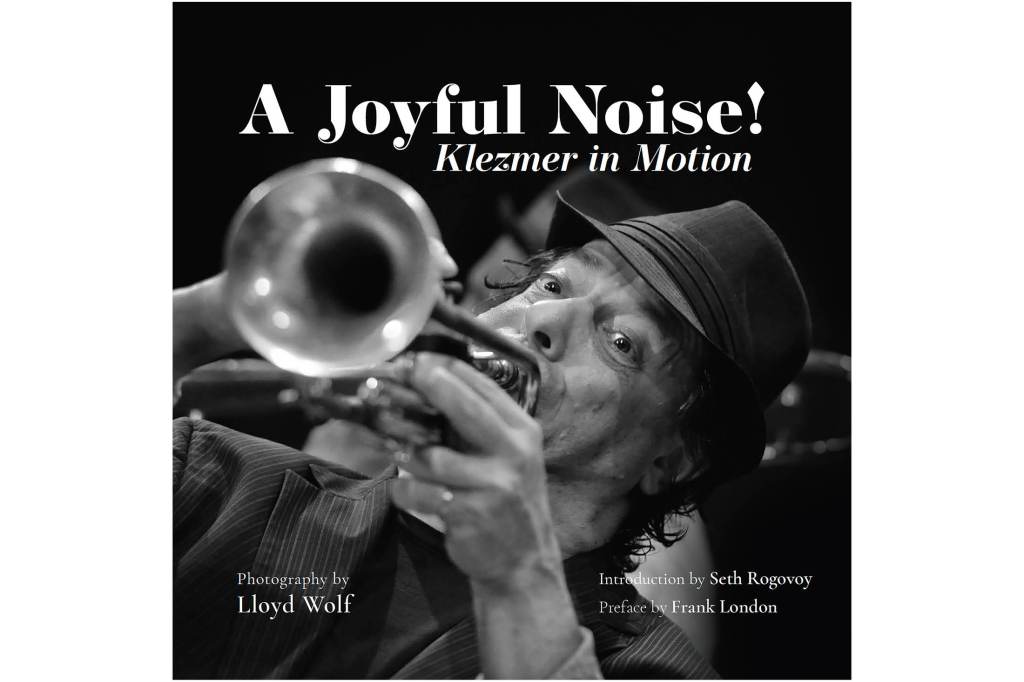
NOTE: Something a little different for PapatamusRedux — a review about a book featuring photos of klezmer musicians. I would encourage fans of music and photography to purchase a copy at https://klezmerinstitute.bandcamp.com/merch/a-joyful-noise-klezmer-in-motion
What Does Klezmer Music Look Like
It’s easy to describe what klezmer music sounds like. It’s the wailing kvetch of the clarinet. It’s the human-like cry of the violin. It’s the lively rhythms of bulgars and freylachs. It’s mournful and joyful, spiritual and improvisational, irresistible and danceable — and all at the same time! But what does it look like? Photographer Lloyd Wolf answers that question in A Joyful Noise, Klezmer in Motion.
In 1992 Wolf was sent on an assignment to New York City by the B’nai Brith’s magazine, Jewish Monthly, to shoot a photo essay on two klezmer revival bands — Kapelye and The Klezmatics. Like most Jewish youth who came of age in the 1950s and 1960s, he remembers hearing Yiddish on the radio in his grandparent’s home. However, the preferred music of his formative years was rock and roll. The Hebrew folk music of that era had little appeal to him and the constant refrains of “Hava Nagila” (what many klezmer musicians refer to as “The H Tune”), which he endured at every bar mitzvah and wedding was cliché. It was the music of those early klezmer revival bands that stirred his soul, and he spent (and is still spending) his time photographing the musicians who are keeping the spirit of Yiddish music alive. As Wolf explains, “while the musicians wail on their instruments, I riff silently on my camera.”
A Joyful Noise, Klezmer in Motion features more than 200 of Wolf’s photos in a classic coffee-table size book. The foreword, written by author Seth Rogovoy (The Essential Klezmer: A Music Lover’s Guide to Jewish Roots and Soul Music), a preface from klezmer musician Frank London and an introduction from the author provide personal and historic backgrounds about klezmer music and its revival. It is Wolf’s evocative black and white and color photos, however, that make that music come alive.
Capturing the Spirit of Klezmer Music
Like the music itself, Wolf’s photos are full of the joy, solemnity, energy and soulfulness that characterizes klezmer music. The cover photo of trumpeter Frank London, an original member of The Klezmatics, is a perfect example. With his eyes bulging and his cheeks full of air, London anticipates his next flurry of notes (in a minor key, of course). There are joyful photos of musicians young and old celebrating this old-world music at Klezkamp, a yearly klezmer and Yiddish culture festival in New York State. Photos of clarinetist Andy Statman, who appeared at Caspe Terrace a decade ago, capture his contemplative side in a stark black and white photo juxtaposed by a dramatic energy-filled color photo. Four separate photos of Pete Rushefsky on the tsimbl (one of the oldest instruments in eastern European Jewish music) shows his various stages of wonderment as he performs for In The Fiddler’s House, a 1995 PBS special that explored the Jewish musical roots through klezmer music. Another photo from that special depicts the joyous smiles of Andy Statman (with mandolin), Hankus Nesky (ethnomusicologist and founder of the Klezmer Conservatory) and world-famous violinist Itzhak Perelman as if noting their approval of a performance.
For pure klezmer joy, there is no better photo than The Klez Dispensers caught in a mid-air jump. The solemnity of a street violinist in Jerusalem’s old city speaks to the universality of the music. With his left hand on the bass notes and his right hand up in the air, accordionist Daniel Kahn encourages the audience to feel the spirit of the music of Vodka and Latkes. There are glorious photos of singers such as Judy Bressler, Sasha Lurje, Defnia Cheb and Polina Shepherd enraptured in the moment of self-expression. There is a sense of satisfaction on the face of David Grisman as he finds just the right notes on his mandolin. Orthodox rabbis may not approve of the photo of accordion player Annette Ezekiel in her leather boots, black nylons and red miniskirt, but it does speak to the youthful appeal of this music.
Although Wolf began photographing the klezmer revival in the 1990s, he did not ignore the musicians of a generation earlier. Drummer Julie Epstein of the Epstein Brothers, a renowned Klezmer musical quartet from the 1940s, stands proudly for a portrait with his drum sticks in hand. Folk singer and star of the Broadway production of Fiddler on the Roof, Theodore Bikel strikes a classic Tevye pose for his photo. Clarinetist Sid Beckerman and pianist Pete Sokolow smile as if to take pleasure in the fact that the music they played in the 1950s is enjoying a resurgence four decades later.
Wolf’s camera not only captures the musicians in action, but he also focuses on the reaction of the audience. The enthusiast crowd on its feet at a Yiddishe Pirat concert could have easily been taken at Woodstock. The dancers at weddings in Washington, D.C., Baltimore, MD and Klezkamp depict how the music’s energy and rhythms translate into human movement. Is clarinetist David Julian Gray more excited about the music or his son’s bar mitzvah as he is raised in a chair with clarinet in hand? There is even a photo of a hand painted guitar case from Klezkamp with the word “shalom” proudly emblazoned in Hebrew.
BOTTOM LINE: When looking at photos, observers often say whether the piece spoke to them or not. Lloyd Wolf’s photos in A Joyful Noise, Klezmer in Motion don’t merely speak — they sing, they dance, they inspire — and that is exactly what klezmer should do as well.







 PAPATAMUS REDUX
Leave a comment