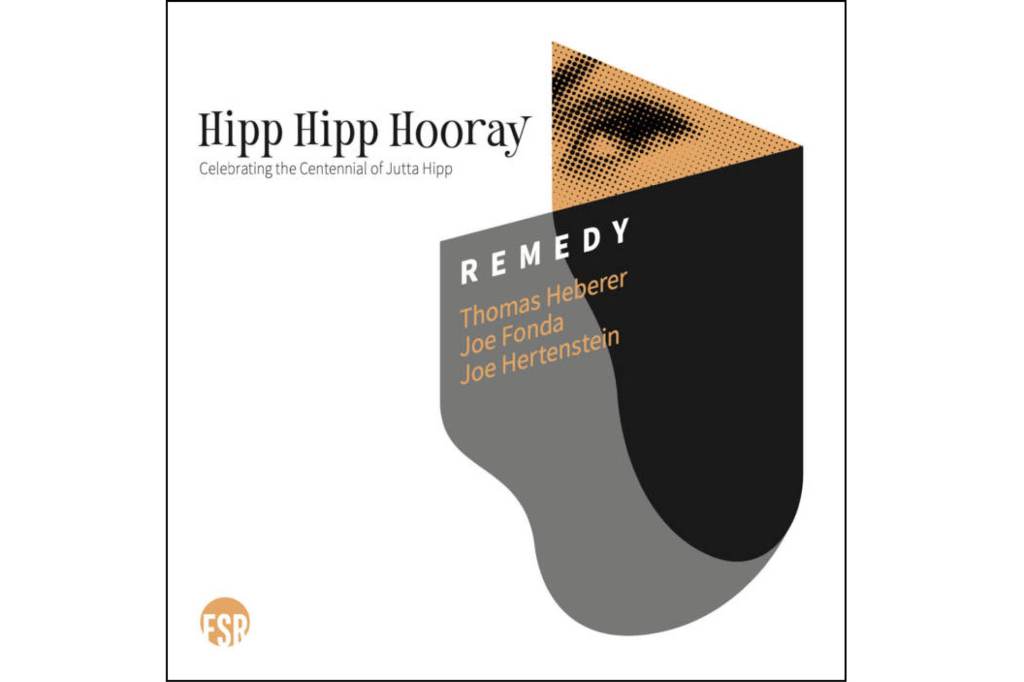
FUNDAJCA SLUCHAJ (RELEASED FEBRUARY 4, 2025)
German pianist Jutta Hipp’s life was full of twist and turns. Born in Leipzig, Germany in 1925, she had to secretly listen to her favorite jazz recordings during the Nazi regime. After the war, Hipp became a displaced person ekeing out a living as a jazz pianist in her native country. Leonard Feather, who heard her perform in Germany in 1954, organized Hipp’s move to America where she performed at clubs and festivals and became the first woman to record for Bluenote Records in 1956. Shortly after that recording, Hipp, who suffered from depression and stage fright, disappeared from the scene and spent the rest of her working years in a New York City clothing factory. The trio of trumpeter Thomas Heberer, bassist Joe Fonda and drummer Joe Hertenstein, known as Remedy, captures those twists and turns on Hipp Hipp Hooray, Celebrating the Centennial of Jutta Hipp. (Note: Like Hipp, Heberer and Hertenstein are both natives of Germany). According to Heberer, from Hipp’s point of view (and many youngsters in 1950s postwar West Germany), the music she loved, and America, were cut from the same cloth — freedom, democracy and promise. Hipp Hipp Hooray captures those ideals in nine originals that allow Heberer, Fonda and Hertenstein to explore all the twists and turns of melodies, harmonies and rhythms. The session begins with the heartfelt “Lionel’s Dream,” a somber piece written in recognition of a son Jutta had to give up for adoption in the late 1940s. The mood shifts as a strong walking bass line introduces “Detroit Meets Leipzig,” a tune that balances bop with free jazz. Heberer explores his full range of trumpet sounds over Fonda’s expressive and expansive bass playing on “Das Brot der Fruhen Jahre.” Fonda’s bowing prowess takes the spotlight on “Bass Bottom,” providing a foundation for Heberer and Hertenstein to cover a lot of musical ground. A recitation about Hipp’s life adds drama to a driving “Der Gruene Zweig.” The final number, “Jutta on Top,” comes closest to the music Hipp was attracted to — an upbeat bebop sounding track. The liner notes clearly state that the goal of Hipp Hipp Hooray was not to emulate Hipp’s style of playing but to capture the essence of her spirit and story through the twist and turns of the music. That is indeed what Heberer, Fonda and Hertenstein do so well on this recording, but you would expect nothing less from Remedy.
BOTTOM LINE: While most jazz musicians celebrate the centennial year of jazz legends by merely recreating the music that made them famous, Remedy, the group of trumpeter Thomas Heberer, bassist Joe Fonda and drummer Joe Hertenstein, chose to celebrate the centennial of German pianist Jutta Hipp on Hipp Hipp Hooray by capturing the twists and turns of her life in nine original compositions.






 PAPATAMUS REDUX
Leave a comment